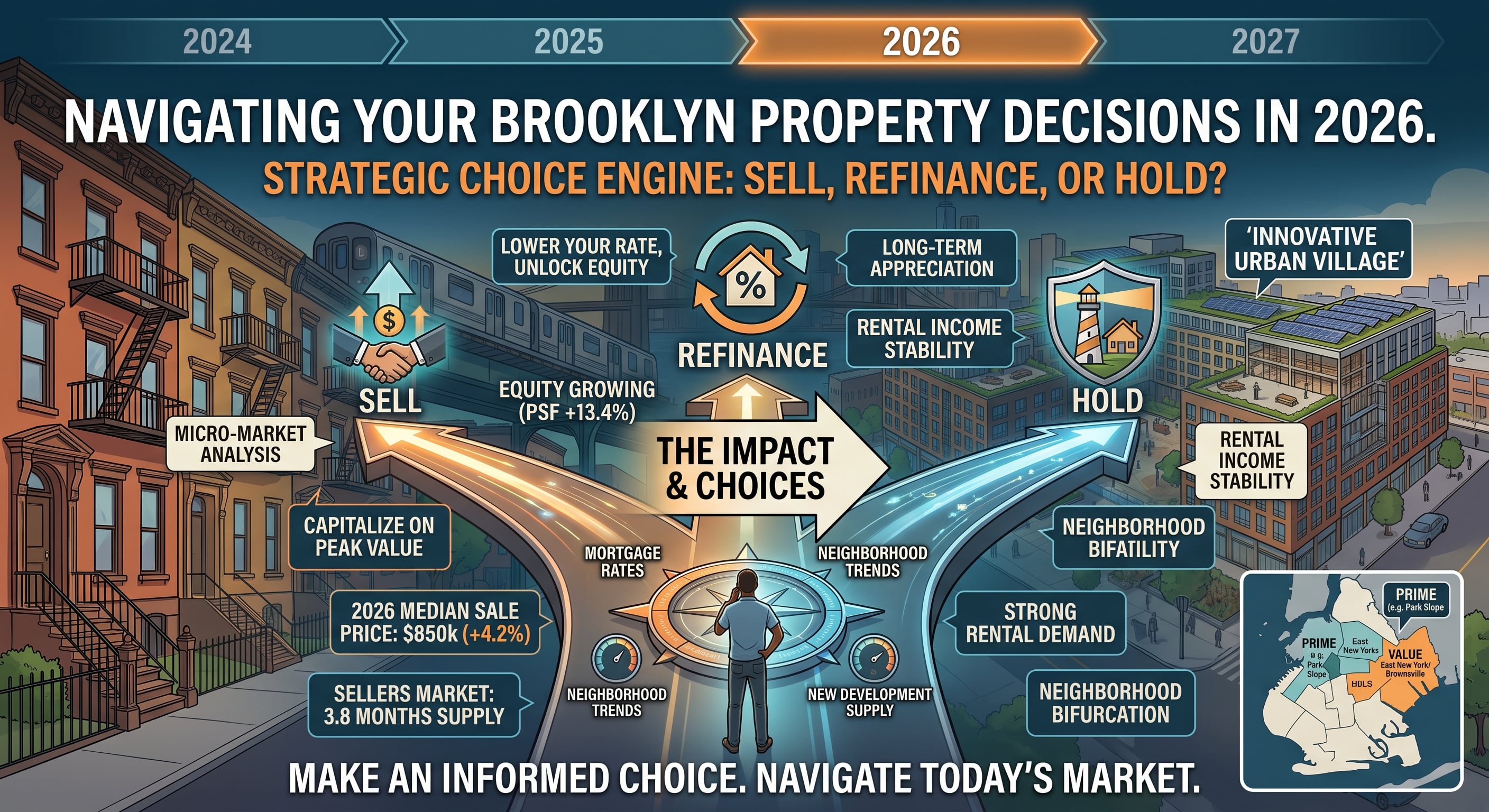
If you own property in Brooklyn right now, you've probably run this question through your head more than once this year. Rates have been anything but stable, home prices keep inching upward even as the pace of sales slows, and rents have hit new records almost every month. Every one of those data points pulls the decision in a slightly different direction depending on your situation, which is exactly why there's no single right answer here, only the right answer for your property, your equity position, and your timeline.
Here's how to actually think through it, using where the market stands right now.
Where Things Stand Heading Into Fall 2026
| Indicator | Current Reading |
|---|---|
| Average 30-year purchase rate | Roughly 6.5% – 6.8% |
| Average 30-year refinance rate | Roughly 6.9% – 7.15%, moving daily |
| Brooklyn median sale price | Approximately $1.05 million, up modestly year-over-year |
| Brooklyn median rent | New record highs reached multiple times through 2026 |
| Brooklyn rental vacancy | Roughly 4%, historically tight |
| Refinance applications | Up over 60% year-over-year as rates dipped from spring highs |
The headline takeaway is that this is a market pulling in two directions at once. Mortgage rates remain elevated and genuinely volatile, sometimes swinging 15 to 20 basis points in a single day, which makes both buying and refinancing feel like a moving target. At the same time, Brooklyn's rental market has been on an almost uninterrupted run of record highs throughout 2026, which changes the math significantly if you're weighing holding a property as a rental against selling it outright.
The Case for Selling
Selling makes the most sense when your equity position is strong and your reason for owning the property doesn't depend on holding it long-term. A few specific situations where selling is worth serious consideration right now:
- You bought years ago and have substantial equity built up. Brooklyn's median sale price sitting around $1.05 million, with steady if modest appreciation, means owners who purchased even five or six years ago are often sitting on meaningful, real gains.
- Your property no longer fits your life. Downsizing, relocating, or consolidating from two properties to one are decisions that market timing shouldn't override. If the property doesn't serve your life anymore, holding it purely to wait for a marginally better rate environment rarely pays off relative to what you give up in flexibility.
- You're sitting on a property that would require significant capital to refinance or improve. If a cash-out refinance or renovation loan would come with a rate near 7%, and the improvements wouldn't meaningfully increase either rental income or resale value, selling and redeploying that equity elsewhere may make more sense than borrowing against it.
The one genuine headwind for sellers right now is pace. Days on market have crept up in parts of the Brooklyn housing market compared to the ultra-fast conditions of a few years ago, which means pricing realistically from day one matters more than it did during the tightest years of the market.
The Case for Refinancing
Refinancing is a much more situational decision than selling, because it depends entirely on the rate you're currently sitting on. The general rule most lenders and mortgage professionals point to: if your current rate sits meaningfully above what's available today, generally above the 7.25% to 7.5% range, refinancing is worth seriously exploring. If your existing rate is already in the low 6% range or below, current refinance rates hovering near 7% likely won't save you money, and you'd be resetting your amortization schedule for no real benefit.
Where refinancing gets more interesting is for owners who locked in rates during the higher-rate window between 2022 and 2025. If that's you, current rates, even with day-to-day volatility, may already represent meaningful savings, and refinance application volume has jumped substantially this year as exactly this group of owners has moved to act.
A cash-out refinance is a separate conversation worth having on its own terms. With Brooklyn rents at record highs, some owners are refinancing specifically to pull equity out and convert a portion of their property, an owner's unit, an accessory unit, a basement apartment, into rental income. Whether that math works depends heavily on your specific rate, your building's configuration, and local rental comps, so this is worth running actual numbers on rather than deciding based on rate headlines alone.
The Case for Holding
Holding is often the quietly correct answer, and it's frequently underrated compared to the more active choices of selling or refinancing. A few scenarios where holding makes the strongest sense right now:
- You already have a rate well below today's market. If you locked in during 2020 through 2022 at a rate in the 3% to 4% range, there is essentially no refinance scenario today that improves your position. Holding preserves that advantage, which is itself a form of ongoing financial benefit that's easy to underweight because it doesn't show up as an active transaction.
- Your property works well as a rental, and you're not in a rush to access the equity. With Brooklyn rents at record highs and vacancy sitting around 4%, a well-positioned rental property is producing strong income right now. Selling into that environment means giving up an income stream that's currently performing better than it has in years.
- You're within a year or two of a major life or financial milestone. If retirement, a career change, or a planned relocation is on the near horizon, it's often worth holding until that event clarifies your next move rather than making a permanent decision now to solve a temporary rate environment.
How to Actually Decide
The honest answer is that this decision comes down to running your specific numbers rather than reacting to market headlines. A useful way to frame it:
Sell if your equity is strong, your life circumstances have changed, and the ongoing carrying costs or upkeep no longer make sense relative to what you'd walk away with.
Refinance if your current rate is meaningfully above today's market, or if a cash-out refinance would let you convert existing equity into income that outperforms the cost of the new rate.
Hold if you're already sitting on a below-market rate, your property is performing well as-is, or you're close enough to a major decision point that acting now would be premature.
None of these are one-size-fits-all, and the right call often comes down to details specific to your building, your neighborhood, and your loan, not the borough-wide averages. If you want an honest, numbers-based read on where your specific property stands, whether that means a current valuation, a rental income analysis, or simply talking through your options, we're happy to walk through it with you.
Mortgage rate and market data referenced above reflects national and Brooklyn-wide averages as of late August 2026 and is subject to daily change. This article is intended as general market education, not individualized financial or lending advice. Please consult a licensed mortgage professional or financial advisor for guidance specific to your situation.
Check out this article next