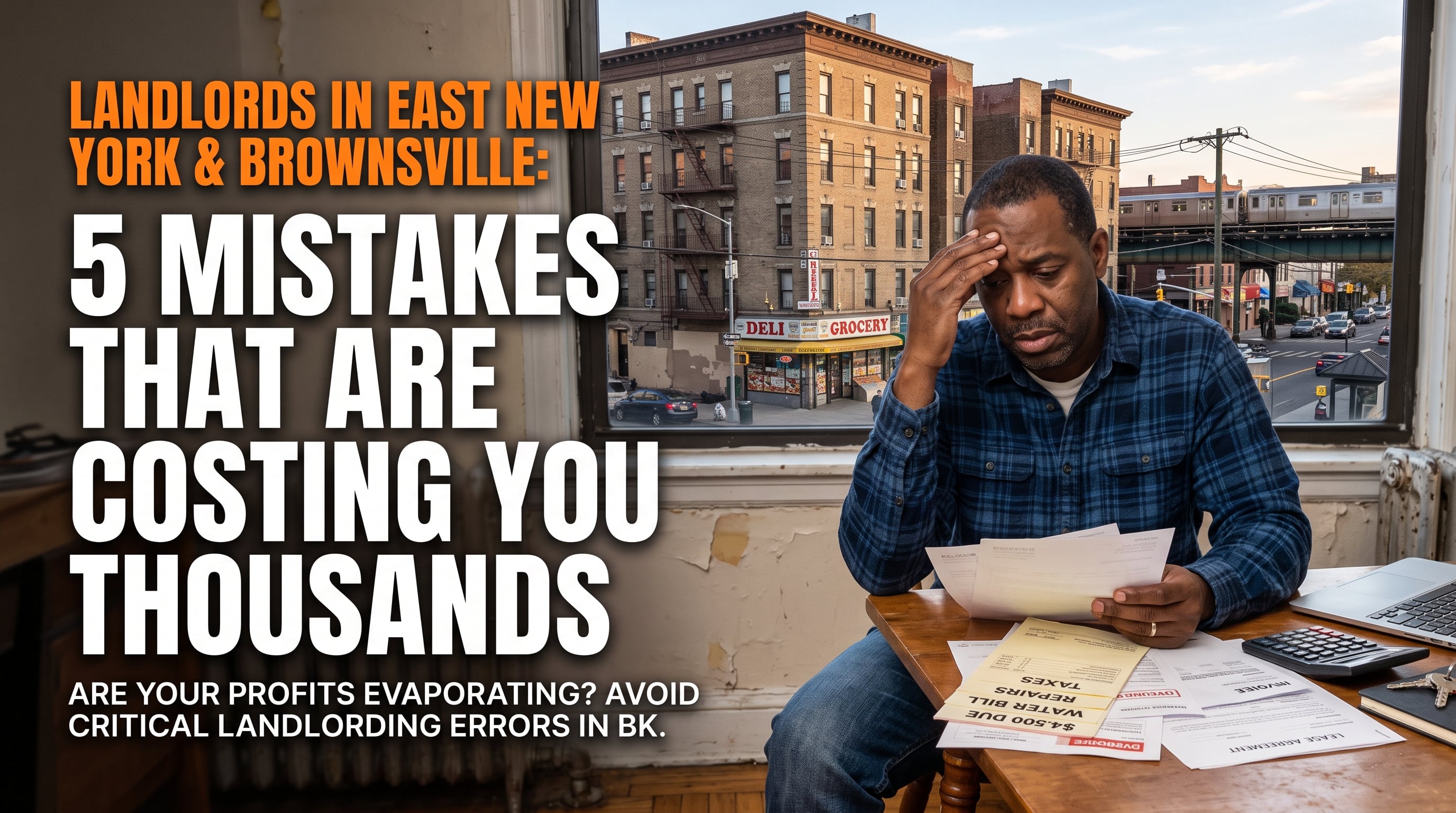
If you own rental property in East New York or Brownsville, you already know these neighborhoods don't behave like the rest of Brooklyn. Rent rolls here can be strong, but the margins get eaten alive by small, avoidable mistakes that most landlords don't even realize they're making until tax season, a vacancy, or a violation notice forces the issue.
We work with landlords across both neighborhoods every month, and the same five mistakes show up again and again. None of them are exotic. All of them are expensive. Here's what to watch for, and what to do instead.
Mistake 1: Pricing the Unit Off Zillow Instead of the Block
East New York and Brownsville are two of the most block-by-block sensitive rental markets in the city. A two-bedroom on Sutter Avenue near the 3 train can rent for meaningfully more than the same layout four blocks south near Linden Boulevard, even though both would show up under the same "neighborhood average" on a national listing site.
The mistake landlords make is pulling a number from an app, subtracting a little for "safety," and listing it. That approach almost always undershoots what the unit could actually command near transit corridors like the 3, the L, or the bus lines feeding into Broadway Junction, and overshoots on blocks further from transit where tenants are far more price sensitive.
What actually works is pricing off comparable closed leases on the same or adjacent blocks, not neighborhood-wide averages. A rental that's priced $75 to $100 too high near Brownsville's quieter interior blocks can sit for six to eight weeks. At that point, the "higher" rent has already cost more than a full year of the discount would have.
The fix: Price by block, not by zip code. If you're not actively tracking closed leases within a five to eight block radius, you're guessing, and guessing here is expensive.
Mistake 2: Skipping (or Rushing) Tenant Screening Because the Unit Has Been Vacant Too Long
This is the single most common thousand-dollar mistake we see. A unit sits empty for five or six weeks, the landlord starts feeling the pressure of a mortgage payment with no rent coming in, and the first applicant who shows up with cash in hand and a plausible story gets approved without a full screen.
In East New York and Brownsville specifically, this mistake compounds faster than in most neighborhoods, because eviction timelines here, like everywhere in NYC, can stretch past a year once a case is contested. A tenant who slips through screening with a spotty payment history or an eviction from a previous landlord isn't a one-time loss of a month's rent. It's potentially a year or more of lost income plus legal costs plus the eventual cost of turning the unit over again.
The pressure to fill a vacancy fast is real. But rushing screening to save four weeks of vacancy has, more than once, cost landlords we know a full year of rent and thousands in legal fees.
The fix: Run full credit, background, and eviction history checks every time, regardless of how long the unit has been sitting. Verify income independently rather than accepting pay stubs alone. If the vacancy is dragging, fix the pricing or the marketing, not the screening standard.
Mistake 3: Treating HPD Violations as "Later" Problems
East New York and Brownsville have some of the higher rates of HPD (Department of Housing Preservation and Development) violations in Brooklyn, and a meaningful number of those violations sit on properties whose owners genuinely didn't know they existed until a tenant complaint, a sale, or a refinance surfaced them.
Here's what makes this expensive rather than just annoying: unresolved violations don't just sit quietly. Class C violations (the hazardous and immediately hazardous category, things like lack of heat, mold, or exposed wiring) accrue penalties that compound the longer they go unaddressed. A violation that would have cost a few hundred dollars to correct in month one can turn into a multi-thousand dollar penalty by month eight, on top of the actual repair cost.
It also affects sale and refinance timing. Open violations show up in title searches and appraisal reviews, and they can delay or kill a deal at the worst possible moment, right when you need the transaction to close on schedule.
The fix: Pull an HPD violation report on your property at least twice a year, not just when something forces the issue. It's a five minute search on the city's website, and it's the cheapest insurance policy available to a landlord in this market.
Mistake 4: Under-Insuring for Multi-Family Risk
A lot of landlords in East New York and Brownsville bought their properties as owner-occupants years ago, moved out, and kept the original homeowner-style insurance policy running because it was simpler than switching. The problem is that a policy built for an owner-occupied one or two family home doesn't cover the same liability exposure as a fully rented multi-family building.
The gap usually shows up in two places: liability coverage that's too low for a building with multiple unrelated tenant households, and loss-of-rent coverage that's either missing entirely or capped too low to matter. If a fire, flood, or structural issue takes a unit offline for three months, a policy without adequate loss-of-rent coverage means the landlord is covering the mortgage on that unit out of pocket while also paying for repairs.
The fix: Have your policy reviewed specifically as a landlord/multi-family policy, not a homeowner policy with rental riders bolted on. This is a conversation worth having with an insurance broker who specifically handles investment property in Brooklyn, since the right coverage level depends heavily on unit count and building class.
Mistake 5: Managing Lease Renewals Reactively Instead of Proactively
The fifth mistake is the quietest one, and it's almost entirely about timing. Landlords who wait until a lease is 30 days from expiring to start the renewal conversation put themselves in a weak negotiating position. The tenant has all the leverage at that point, because the landlord is now racing the clock against a potential vacancy, and tenants who sense that hesitation will often push back harder on a rent increase, or simply not respond at all until the lease has already lapsed into month-to-month.
In East New York and Brownsville, where the rental pool skews toward tenants with long tenure once they're settled, this mistake is particularly costly because it's recurring. A landlord who loses negotiating leverage on renewal timing once tends to lose it every year with that same tenant, compounding a below-market rent year over year.
The fix: Start the renewal conversation 90 days out, not 30. Send a written notice with the proposed renewal terms early enough that the tenant has real time to plan, whether that means accepting the increase or giving proper notice to move. Landlords who do this consistently see far less pushback and far fewer surprise vacancies.
The Common Thread
None of these five mistakes are about bad luck or a difficult market. Every single one of them is a process problem, pricing without local data, screening under pressure, ignoring violations until they compound, carrying the wrong insurance, and negotiating renewals from a position of weakness. Fix the process, and the thousands of dollars these mistakes cost tend to disappear along with them.
If you own rental property in East New York, Brownsville, or anywhere else in Brooklyn and want a second set of eyes on your pricing, your screening process, or your renewal strategy, we're happy to walk through it with you. A short conversation now is a lot cheaper than any one of the five mistakes above.
Check out this article next